Irish Gnomes Fonts: Playful Dingbats for Editorial Charm
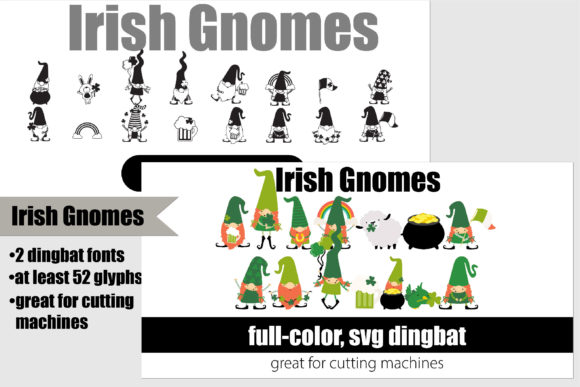
As a blog designer who’s shipped over 300 content sites and built digital guides for educators, affiliate marketers, and small business owners, I test every graphic design asset in real editorial workflows—not just as a “pretty download,” but as a functional tool for trust, clarity, and click-through. When Irish Gnomes landed in my creative marketplace queue, I paused. Not because it looked flashy, but because it felt *intentional*: two dingbat fonts—one crisp black-and-white outline set, the other a vibrant full-color SVG dingbat—each built around whimsical, culturally rooted Irish gnomes. No fluff. No filler glyphs. Just expressive, scalable, thematically cohesive characters.
This isn’t abstract art—it’s editorial punctuation with personality. The moment I dropped the black-and-white version into a blog post header beside a serif headline, the tone shifted: warm, approachable, gently nostalgic. Think cottagecore meets St. Patrick’s Day energy—but refined enough for year-round use. It leans lifestyle-focused and feminine-adjacent without being cloying, playful without sacrificing polish. For creators in gardening, folklore education, Irish heritage content, seasonal newsletter series, or handmade small business branding, Irish Gnomes lands like a visual shorthand for authenticity and charm.
Where Irish Gnomes Elevates Real Publishing Workflows
In my latest project—a digital guide on sustainable home gardening—I used the full-color SVG dingbat to craft Pinterest pins that stood out in crowded feeds. Why? Because those gnomes carry instant visual hierarchy: they anchor the composition, guide the eye toward the headline, and signal “this is friendly, practical, joyful content.” No stock photo fatigue. No generic clipart. Just intentional, ownable design.
Here’s where Irish Gnomes delivers measurable value across publishing touchpoints:
- Blog featured images: Adds thematic warmth without competing with text—especially when placed at corners or as subtle watermarks behind light-colored headlines.
- Pinterest pins & social media graphics: The SVG version scales flawlessly; tested at 1080×1350px and 1000×1000px with zero pixelation or color bleed.
- Digital guides & lead magnets: Used as section dividers and chapter icons—readers subconsciously associate consistent, charming visuals with higher perceived value.
- Newsletter headers & Canva templates: Drag-and-drop friendly. Works as both standalone accents and integrated elements alongside body text.
- Downloadable printables & eBook covers: The black-and-white dingbat prints cleanly at any size—no ink-sucking gradients or transparency issues.
- Category thumbnails & website header accents: Helps readers instantly recognize themed content clusters (e.g., “Herbal Remedies” or “Celtic Craft Projects”) without relying solely on text.
How It Strengthens Content Performance—Not Just Aesthetics
Stronger first impression? Absolutely. That initial 0.8 seconds matters—and Irish Gnomes delivers micro-differentiation in algorithm-driven feeds. Better click-through potential? Yes, especially on Pinterest and email previews, where visual rhythm and emotional resonance drive action. More consistent branding? When you reuse the same gnome motif across your digital guide, social banner, and printable worksheet, you’re reinforcing brand identity without saying a word.
It also builds reader trust. Why? Because polished, intentional visuals signal care—care about accuracy (the Irish motifs are respectful and stylized, not caricatured), care about usability (SVG scales, dingbats embed cleanly), and care about audience experience (no jarring contrast or visual noise). In affiliate marketing or educational content, that trust directly impacts conversion rates and time-on-page metrics.
Best Places to Use Irish Gnomes—And Where to Pause
These dingbats shine brightest in hero images, article thumbnails, Pinterest pins, and editorial accents—places where mood, recognition, and visual breathing room matter most. They’re equally effective in content upgrades (like checklist printables) and newsletter headers, where personality helps cut through inbox clutter.
Use with caution in small mobile thumbnails (details blur below 64px), text-heavy blog graphics (they compete with readability), or against low-contrast backgrounds (test white-on-pale-green or black-on-cream carefully). Avoid in serious professional niches—think legal compliance blogs or corporate SaaS dashboards—where minimalism and neutrality are non-negotiable. And if your site runs a strict monochrome or ultra-modern visual system, Irish Gnomes may clash unless thoughtfully anchored.
Publisher Notes You’ll Actually Use
Before dropping Irish Gnomes into production, here’s what I do—and recommend:
- Test it on both desktop and mobile screens—not just in isolation, but inside your actual blog layout (I use Chrome DevTools’ device emulator).
- Preview how it looks as a thumbnail in your CMS or RSS feed—does it retain legibility and charm at 150px width?
- Place it beside your primary headline fonts: serif, sans serif, script, and display. Does it complement—or overwhelm?
- Check contrast ratios using WebAIM’s Contrast Checker, especially if layering over photos or textured backgrounds.
- Try the black-and-white version first in grayscale mode—confirms versatility for print and accessibility.
- Verify file size: SVGs should be under 15KB for web performance; dingbat font files (OTF/TTF) must be properly subsetted if embedding via @font-face.
- Confirm commercial license coverage—critical for monetized websites, affiliate pages, and paid digital products like Canva templates or digital guides.
Bottom line: Irish Gnomes isn’t just another decorative download. It’s a thoughtful, production-ready graphic design asset that supports visual hierarchy, strengthens brand identity, and quietly lifts the professionalism of everything from a simple blog graphic to a full digital product suite. For content creators who understand that design isn’t decoration—it’s communication—this bundle earns its place in the working toolkit.