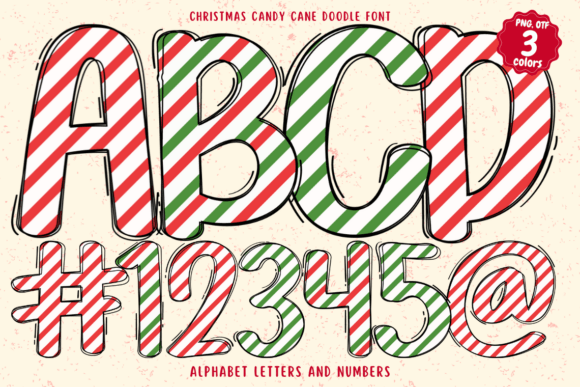
Christmas Candy Cane Doodle
A Whimsy That Stitches—Not Just a Font, But a Holiday Mood
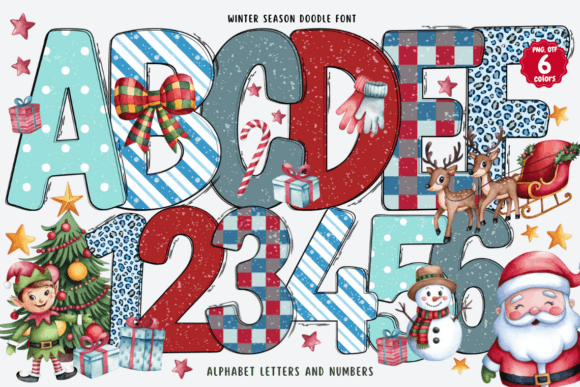
When I opened Christmas Candy Cane Doodle for the first time, I didn’t just see letters—I saw a sugar-dusted, hand-drawn holiday moment. This isn’t a crisp serif or a sleek sans; it’s a Color Fonts typeface built from playful candy cane swirls, tiny peppermints, and looping ribbons that feel like they were sketched with a fine-tip marker on vintage wrapping paper. As an embroidery designer who’s stitched hundreds of seasonal projects—from boutique baby onesies to Etsy sweatshirt collections—I immediately asked: Does this translate to thread? Does it hold up when scaled down for a patch? Will my customers recognize the charm—or just see clutter?
Real-World Test: A Hand-Embroidered Tote Bag for a Local Craft Fair
Last week, I prepped a limited run of holiday tote bags for a downtown maker market—cotton canvas, medium weight, 8" × 10" hoop space. I chose Christmas Candy Cane Doodle for the phrase “Merry & Muddled” (a lighthearted nod to real holiday chaos). At 3.2" tall, the design sat comfortably in the hoop—but only because I avoided the tightest corners of the lettering. The doodle elements—especially the tiny striped swirls dotting the “O”s and curling around the “Y”—needed careful stitch-density review. On screen, they looked joyful. Under needle? They risked becoming fuzzy blobs without proper stabilizer and slightly reduced fill stitch density.
Where It Shines (and Where It Pauses)
Christmas Candy Cane Doodle excels in projects where personality outweighs precision:
- Embroidered patches for kids’ backpacks or denim jackets—its irregular rhythm feels handmade, not machine-made.
- Sweatshirt embroidery on crewnecks or hoodies, especially over fleece or French terry, where soft texture absorbs some line variation beautifully.
- Personalized gifts like tea towels or pillow covers—customers love the nostalgic, kitchen-table warmth it brings.
- Boutique branding for small shop packaging or holiday tags—paired with clean sans-serif body text, it adds instant seasonal voice without shouting.
But be thoughtful with placement. On stretchy fabric like ribbed knit baby caps or curved surfaces like structured trucker hats, the doodle flourishes can distort unless digitized with stretch compensation—or better yet, used as a standalone accent rather than full-word text. And on dark fabric, avoid light pastel thread unless you’re adding a white underlay; those delicate candy cane stripes need contrast to read.
What Your Customers Actually Notice (and Why It Matters)
Let’s be honest: most buyers don’t care about kerning or vector anchors. They feel tone. When someone picks up your embroidered apron and smiles at the winking candy cane loop in the “C,” that’s Christmas Candy Cane Doodle doing quiet brand work. It signals playfulness, care, and seasonal intention—not generic holiday clip art. That emotional resonance lifts perceived value. A $24 tote bag with this font feels more curated than one with standard script. For Etsy sellers and craft fair vendors, that difference translates directly to repeat buyers and photo-worthy unboxings.
Designer Notes You’ll Thank Yourself For Later
- Always test on scrap fabric first—especially if using textured weaves or blends. That peppermint dot in the “P”? It may vanish on heavy linen unless you adjust stitch length.
- Check thread color contrast early. Red-and-white candy cane motifs are festive, but red thread on burgundy fabric loses legibility fast.
- Review stitch density. High-density fills in curly doodles can pucker lightweight cotton—opt for lighter fill or add a tear-away + cut-away stabilizer combo.
- Confirm hoop size compatibility. Some letters extend beyond standard 4×4 boundaries—scale thoughtfully or split across two hooping passes.
- Inspect small details in black-and-white mockups. What reads as charming on-screen might blur into indistinct gray when stitched.
- Verify licensing before selling finished products. As a Fonts product, its commercial use terms affect whether you can embroider and resell physical items—or bundle it into digital embroidery files for others.
Fabric, Function, and Feeling
I’ve used Christmas Candy Cane Doodle on everything from organic cotton baby burp cloths (scaled to 2") to heavyweight canvas aprons (at 4.5"). Its strength lies in adaptability—not uniformity. On thin fabric, I skip dense satin-stitch outlines and lean into running-stitch doodles instead. On layered garments like quilted holiday stockings, I simplify by using only the candy cane stem as a border motif—not the full alphabet. It’s not a one-size-fits-all machine embroidery design; it’s a mood you curate.
Final Thought: Charm Needs Context
This isn’t a font for corporate holiday cards or minimalist monogramming. Christmas Candy Cane Doodle belongs where joy is handmade, slightly imperfect, and deeply intentional—on a mug cozy stitched for a teacher, a custom onesie for a newborn’s first Christmas, or a patch sewn onto a thrifted coat by a teen entrepreneur. It rewards attention. It asks you to slow down, choose thread deliberately, and consider how each swirl will land on fabric—not just in pixels. That’s the kind of detail that turns a simple embroidery project into a story people want to hold, wear, and share.