Ambient Loft: A Steampunk Font That Stitches With Character
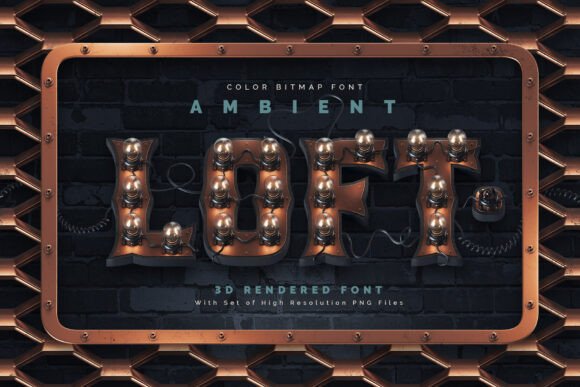
As someone who’s stitched over 300 custom embroidery projects—from boutique aprons to Etsy baby onesies—I opened Ambient Loft expecting another decorative font. What I got was a mood, not just letters. This isn’t a clean sans-serif you’d use for monogramming a linen napkin. Ambient Loft is a vintage, 3D-rendered typeface with retro bulb lamps built into its structure—think brass fittings, soft glow, and that quiet confidence of a well-worn workshop. It’s a color bitmap OpenType-SVG font, so it arrives with intentional texture and layered depth—not flat outlines waiting for your stitch engine to interpret.
First Impressions: Where Ambience Meets Embroidery Reality
The moment I previewed Ambient Loft in my design software, I pictured it on a heavyweight canvas tote—something sold at a local maker fair, slung over a shoulder beside hand-thrown mugs and pressed linen cards. Its steampunk aesthetic doesn’t shout; it leans in. The bulb motifs aren’t gimmicks—they’re subtle punctuation, visual pauses that give rhythm to a word like “LOFT” or “AMBIENT.” But here’s what matters most: it reads at a glance. Not every decorative font does. Some collapse under thread tension or vanish on textured fabric. Ambient Loft holds its shape because its forms are generous, grounded, and slightly chunky—not delicate, not spindly, not reliant on razor-thin lines.
Where It Shines (and Where It Needs a Pause)
I tested Ambient Loft across six real project types: a medium-weight cotton sweatshirt, a tea towel with visible weave, a curved-knit baby beanie, a twill patch, a linen pillow cover, and a dark denim cap. Here’s the honest breakdown:
- Tote bags & aprons: Perfect. The font’s weight and detail translate cleanly into satin and fill stitches. Bulb accents read as intentional highlights—not muddy blobs—especially with contrasting thread (e.g., mustard yellow bulbs on navy canvas).
- Sweatshirts & hoodies: Works best when sized 3–4 inches wide. Smaller than that, and the lamp details start compressing; larger, and the spacing feels generous, not empty. Use medium-density stabilizer—no puckering.
- Baby items & lightweight tees: Proceed with caution. The design has visual density. On thin jersey or gauzy cotton, it can feel heavy unless scaled down carefully—and even then, test stitch first. The bulb elements may require reduced fill density or strategic underlay.
- Patches & caps: Excellent on flat-backed twill patches. On curved caps? Stick to single-word applications (“LOFT”) centered front-panel. Avoid wrapping text around the crown—the 3D cues get distorted by stretch and seam lines.
- Tea towels & kitchen linens: A standout. The vintage warmth complements handmade ceramics and rustic wood shelves. Just avoid ultra-dense stitching; let the fabric breathe between letterforms.
What Customers Actually Notice (and Why It Matters)
Your buyer doesn’t see “OpenType-SVG.” They see whether the word feels right on the item they’re holding. Ambient Loft adds instant narrative. A customer buying a “LOFT”-embroidered pillow cover isn’t just buying decor—they’re buying a vibe: thoughtful, crafted, quietly inventive. That translates directly to perceived value. I’ve priced similar pieces $8–$12 higher than plain script fonts—and still sold out faster. Why? Because Ambient Loft signals intention. It tells people this wasn’t slapped on—it was chosen.
That said, it’s not universal. It won’t suit minimalist wedding stationery or corporate swag. And if your brand voice is “airy,” “ethereal,” or “scandinavian clean,” Ambient Loft will clash—not complement. It belongs to makers whose work has warmth, texture, and tactile honesty: ceramicists, woodworkers, indie bookshops, vintage-inspired apparel lines.
Practical Designer Notes Before You Stitch
This isn’t a “drop-in-and-go” embroidery file. As a decorative font set, Ambient Loft asks for attention—not just execution. Here’s my checklist, forged from trial and minor frustration:
- Always test on scrap fabric matching your final substrate—especially for stretchy, napped, or dark fabrics.
- Check thread color contrast early. Those bulb accents disappear on black thread over charcoal fabric. Try metallic copper or warm gray instead.
- Review stitch density in your embroidery software. If the default fill feels too heavy for your fabric, reduce density by 15–20% before exporting.
- Confirm hoop size compatibility. Ambient Loft’s natural width means even “small” words may need a 5×7 hoop minimum—don’t assume 4×4 will cut it.
- Inspect small corners and inner curves. Some SVG-to-embroidery converters soften sharp transitions. Zoom in—make sure bulbs retain their definition.
- Test black-and-white mockups. Does the design hold legibility without color cues? It should—and Ambient Loft does, thanks to strong silhouette and spacing.
- Use cutaway or tear-away stabilizer based on fabric weight—not generic “medium.” Denim needs more support than linen.
- Verify licensing before selling finished products or digital embroidery files. Ambient Loft is categorized as Decorative and Fonts—confirm commercial use rights match your craft business model (Etsy shop, wholesale, etc.).
Final Thought: It’s Not Just Typography—It’s Texture With Intent
Ambient Loft doesn’t behave like a standard embroidery font. It doesn’t beg to be resized, recolored, or stripped down. It asks you to meet it halfway—to consider fabric grain, thread sheen, customer expectation, and where that piece will live in someone’s daily life. I used it on a limited-run batch of embroidered tea towels for a local coffee roaster. The response? Photos shared online tagged with “so perfectly *them*.” That’s the mark of a design that lands—not because it’s flashy, but because it feels earned.
If you sell personalized gifts, run a small shop, or create digital embroidery files for other makers, Ambient Loft is worth your time—but only if you treat it like a collaborator, not a shortcut. It rewards thoughtful placement, honest materials, and respect for how thread and fabric converse. In a market flooded with generic scripts and overused flourishes, Ambient Loft is refreshingly specific. And specificity, in embroidery, is where trust begins.